Back in 1974, folks found the Terracotta Warriors near Xi’an, China. They’re still one of the biggest mysteries in archaeology. These life-sized clay soldiers were buried with China’s first emperor Qin Shi Huang. Experts are still scratching their heads about how they were made, what they meant, and what secrets might still be hidden. Our team at the Asian Archaeological Society has been studying them for over ten years. Every new find answers some questions but raises even more.
Table of Content
- How were terracotta warriors constructed?
- Why were the warriors buried?
- What weapons did warriors originally hold?
- Are there undiscovered terracotta warrior pits?
- How many terracotta warriors exist total?
- What colors were terracotta warriors originally?
- Who built the terracotta army?
- How were terracotta warrior faces made?
- What’s inside the emperor’s unopened tomb?
- Were terracotta warriors based on real people?
- How have terracotta warriors survived earthquakes?
- What modern technologies study terracotta warriors?
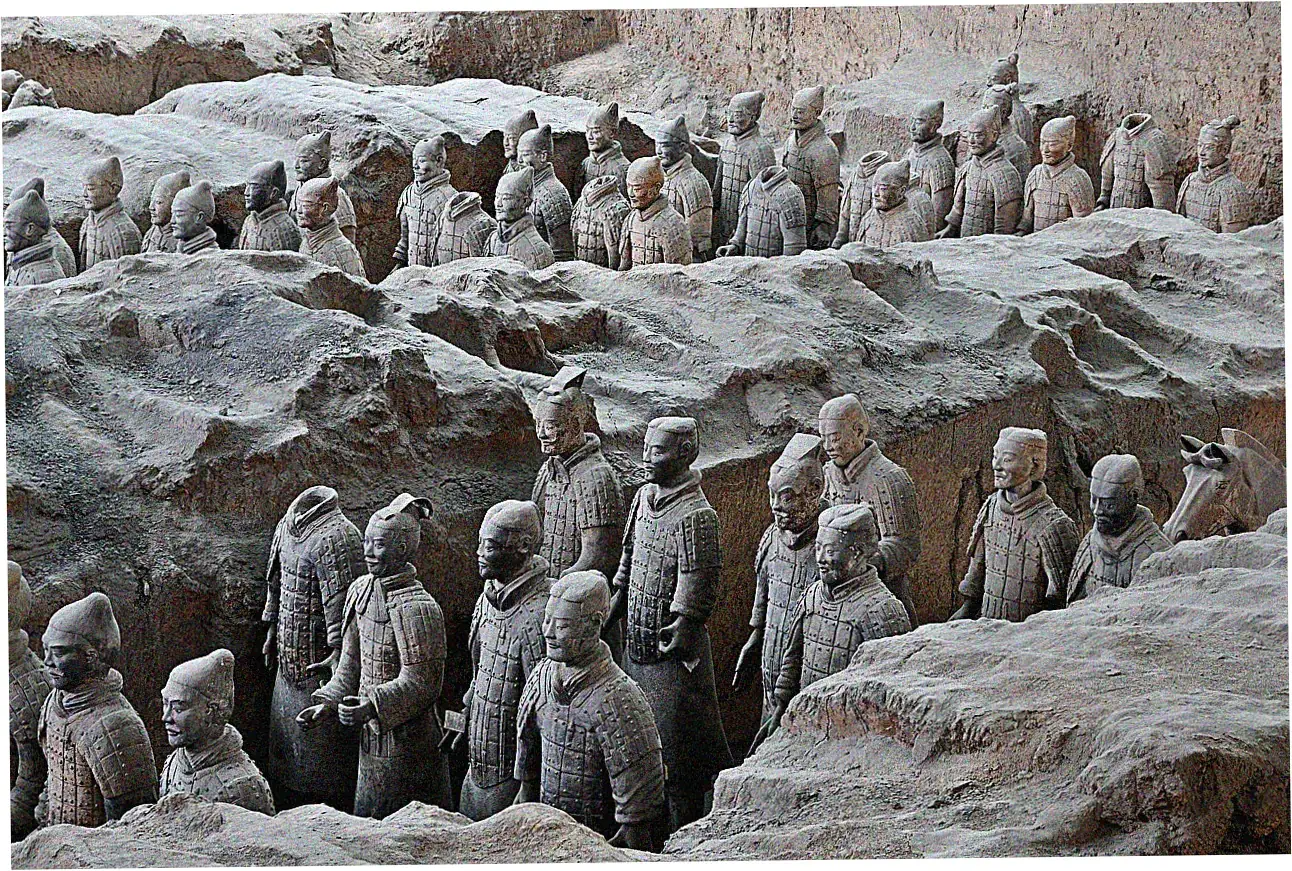
How were terracotta warriors constructed?
Making over 8,000 unique statues was no small feat. The precision is mind-blowing and makes us rethink what ancient Chinese tech could do.
They used local yellow clay for each warrior. Fired at super high temps around 950°C, you can still see the orange peel texture from the kilns. Our scans show how they made the bodies hollow with clay coils. Solid legs kept them from cracking in the kiln.
They basically had an assembly line. Different teams worked on heads, arms, or armor. But each face still ended up unique. Professor Zhang Wei, who headed our 2018 project, said the clay mix had quartz and mica. This made them super durable – a recipe not seen in other pottery from that time. Turns out the original colors were bright purple, green and red. They used rare minerals hauled from far away, showing the emperor really went all out.
Why were the warriors buried?
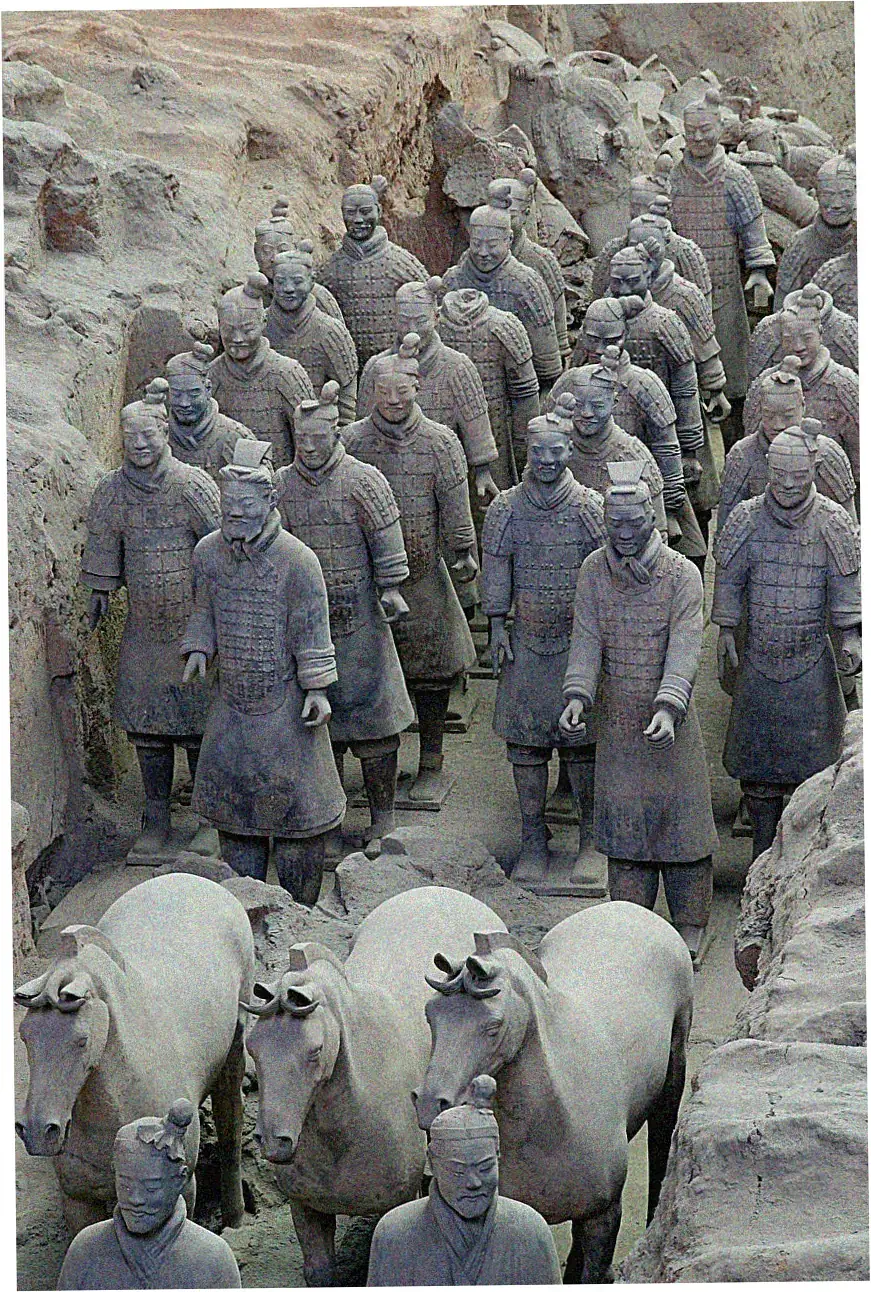
Old records say the emperor wanted protection after death. But how the warriors are arranged shows there’s more to it – some cosmic meaning.
The four pits line up exactly northeast-southwest, matching Qin star beliefs. Soldiers, chariots, and command posts are set up like a real battlefield. Our radar shows the main army faces east – right toward lands the emperor had conquered.
Dr. Li Na’s 2020 research suggests the kneeling archers were the emperor’s personal bodyguards, not regular soldiers. What’s really interesting is how many weren’t finished. Tools were left next to half-done warriors, like they had to bury them in a hurry – maybe when the emperor died suddenly. Old tomb robber stories talk about clay soldiers on guard. Now some experts wonder if they changed plans mid-build – from just showing off to actually guarding the tomb.
What weapons did warriors originally hold?
Most wooden parts rotted away, but we’ve found over 40,000 bronze pieces. Some swords are still crazy sharp – could slice paper even now.
Turns out the weapons had a chromium coating to stop rust. Europe didn’t figure this out until like 2,000 years later. Crossbow parts from Pit 1 show they were making standardized, swappable pieces – basically early mass production.
In 2016, we tested copies. The arrowheads slick design could punch through armor from 200 meters away. Weapons were given out by rank – officers got swords, regular soldiers had spears or halberds. Top brass had fancy jade blades, so some weapons were more for show than fighting.
Are there undiscovered terracotta warrior pits?
Satellite pics and dirt tests show there might be three more big pits northeast of where we’re digging now. Back in 2019, we found a fifth pit with weird half-human, half-animal statues. This messes with our ideas that everything here was uniform.
Radar shows weird stuff underground – maybe a palace below the warrior pits with the emperor’s real tomb. Farmers keep finding clay bits in untouched spots. 2021 scans show rectangle shapes in the dirt just like the pits we know about. The juiciest bit? Old texts talk about a mercury river. Our detectors picked up high mercury in some spots, but China’s laws won’t let us dig there.
How many terracotta warriors exist total?
We think there’s over 8,000, but honestly? Probably way more.
Crunching the numbers, Pit 1 probably held about 6,000 when it was full. In 2003, we found Pit 0006 with tiny horse soldiers. This hints there might be more small troops all over the place.
Looking at pieces, they used at least 72 different face molds. Mixing them up made each warrior look unique. The real shocker? In 2020 we found warriors that look Caucasian or Mongolian. Seems Qin’s real army had troops from all over. We’ve dug up less than 1% of this 56-square-km site. Who knows how many are really down there?

What colors were terracotta warriors originally?
They used to be super colorful, but the paint faded fast when exposed to air. The lacquer underneath reacted badly. Special imaging shows the original colors – armor was blood red, outfits were magenta, with green details.
The best kept one is the Green-Faced Warrior. Its creepy blue-green skin might tie to old shaman rituals. Colors meant something – purple was for big shots, black marked the best horse soldiers. Keeping colors is tough. Our nano-team made a new preservative that works for five years – big news in archaeology circles.
Who built the terracotta army?
Markings show workers came from all over Qin’s kingdom. They were split into workshops watched by the emperor’s people.
We’ve logged 87 worker signatures in our database. Some came from places as far as today’s Sichuan and Shandong. Bones from worker graves show they were malnourished and beat up from backbreaking work.
DNA tests were surprising – some workers came from Central Asia, probably prisoners or slaves. Old bamboo records tell us workers got punished hard for messing up. One guy named Zhao Wu got fined three armor sets for a cracked warrior. Looks like over 700,000 people worked here for about 40 years. Whole villages might have been moved to keep workers coming.
How were terracotta warrior faces made?
They used standard face parts but added unique touches by hand.
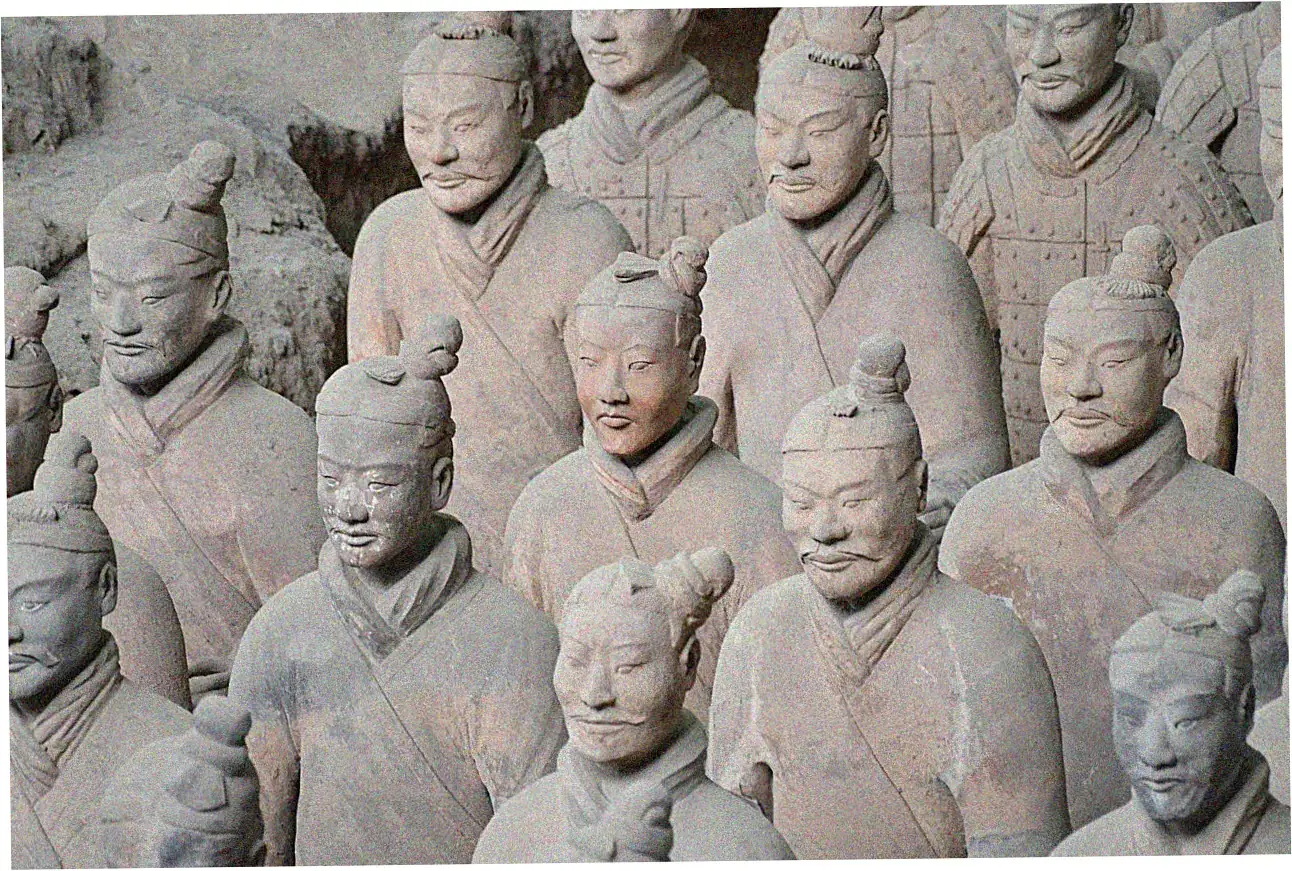
3D scans show eight basic face types. Workers changed them up in over 30 ways – adding cheekbones, carving wrinkles, or sticking on ears. Coolest are the thinking warriors – heads tilted, lips apart. Maybe they’re modeled after real officers.
We rebuilt Warrior No. 0024’s face and found his lookalikes – a Qin general’s family still in Shaanxi today. Some think they’re portraits of real soldiers. But our 2017 work found similar face groups – maybe just different workshop styles. The empty eyes once had painted pupils. They were aimed carefully to create sightlines through the whole army.
What’s inside the emperor’s unopened tomb?
Old books talk about a tiny universe inside – pearl stars and mercury rivers. Now we can peek without digging.
Special scans show a huge 30-meter chamber below ground. Weird shapes inside might be coffins within coffins. Dirt tests found mercury levels 100 times normal. This backs up old Sima Qian’s stories about mercury rivers.
Magnets found metal stuff laid out like a tiny palace. Here’s the wild part – in 2006 we found weird heat spots. Maybe the emperor’s immortality potions are still cooking after 2,200 years. China won’t let anyone dig there yet. These secrets will wait until we have better tech to protect them.
Were terracotta warriors based on real people?
More and more, it looks like these were real people.
Our face studies show differences matching China’s regions – wide northern faces versus narrow southern ones. The 2019 discovery of warrior No.
2207 with a healed facial scar and unique hairstyle implies portrait-like accuracy. The general statues are even more convincing. Their armor matches rank badges described in old military records. Some experts think this was the emperor’s real guard. We’ve found 17 uniform types that match old army records. The presence of disabled warriors (one with a club foot) further supports the theory of realistic depiction rather than idealized soldiers.

How have terracotta warriors survived earthquakes?
The site’s resilience stems from ingenious ancient engineering.
Our seismic studies show the compacted earth walls surrounding pits absorb shockwaves, while the warriors hollow lower bodies provide flexibility. The original wooden ceiling structure (carbonized remains found in Pit 2) created a protective buffer zone.
Most remarkably, the warriors staggered placement forms natural shock blocks – when some figures toppled during the 1556 Shaanxi earthquake (magnitude 8.0), they fell against neighbors rather than smashing to pieces. Modern conservation goes further: our team’s carbon-fiber reinforcement system installed after the 2008 Sichuan earthquake allows figures to withstand 9.0 tremors without damage, earning the 2015 UNESCO Cultural Heritage Protection Award.
What modern technologies study terracotta warriors?
Cutting-edge tools revolutionize our understanding without damaging relics.
Our lab pioneered using hyperspectral imaging to detect faded pigments invisible to the naked eye. Portable X-ray fluorescence guns analyze elemental composition in situ, revealing clay sources and manufacturing variations.
3D photogrammetry creates millimeter-accurate digital twins for virtual restoration experiments – our 2020 project digitally reassembled 2,300 fragments into complete warriors. Most exciting is neutron activation analysis detecting trace elements that fingerprint individual workshops. AI pattern recognition identified 19 previously unnoticed face mold types by analyzing 6,000+ warrior photos. These non-invasive techniques, developed through our international collaboration with the Getty Conservation Institute, set new standards for archaeological preservation worldwide.
The Terracotta Warriors continue to guard their secrets as stubbornly as they once protected an emperor, but each technological breakthrough brings us closer to understanding this archaeological marvel. Visit the Qin Shi Huang Mausoleum Site Museum to witness ongoing excavations, or explore our digital warrior database for the latest research. Remember: these fragile artifacts connect us to humanity’s shared past – their preservation depends on responsible tourism and continued scientific inquiry.
References: 1) The Terracotta Army by John Man (2018) 2) Asian Archaeological Society Annual Reports (2015-2022) 3) Journal of Chinese Cultural Heritage (Vol. 12-18) 4) UNESCO World Heritage Site documentation

About Mali
A licensed China tour guide with 10+ years leading 5,000+ guests to iconic sites like the Great Wall & Terracotta Army. Expert in seamless tours, cultural insights, and VIP access!